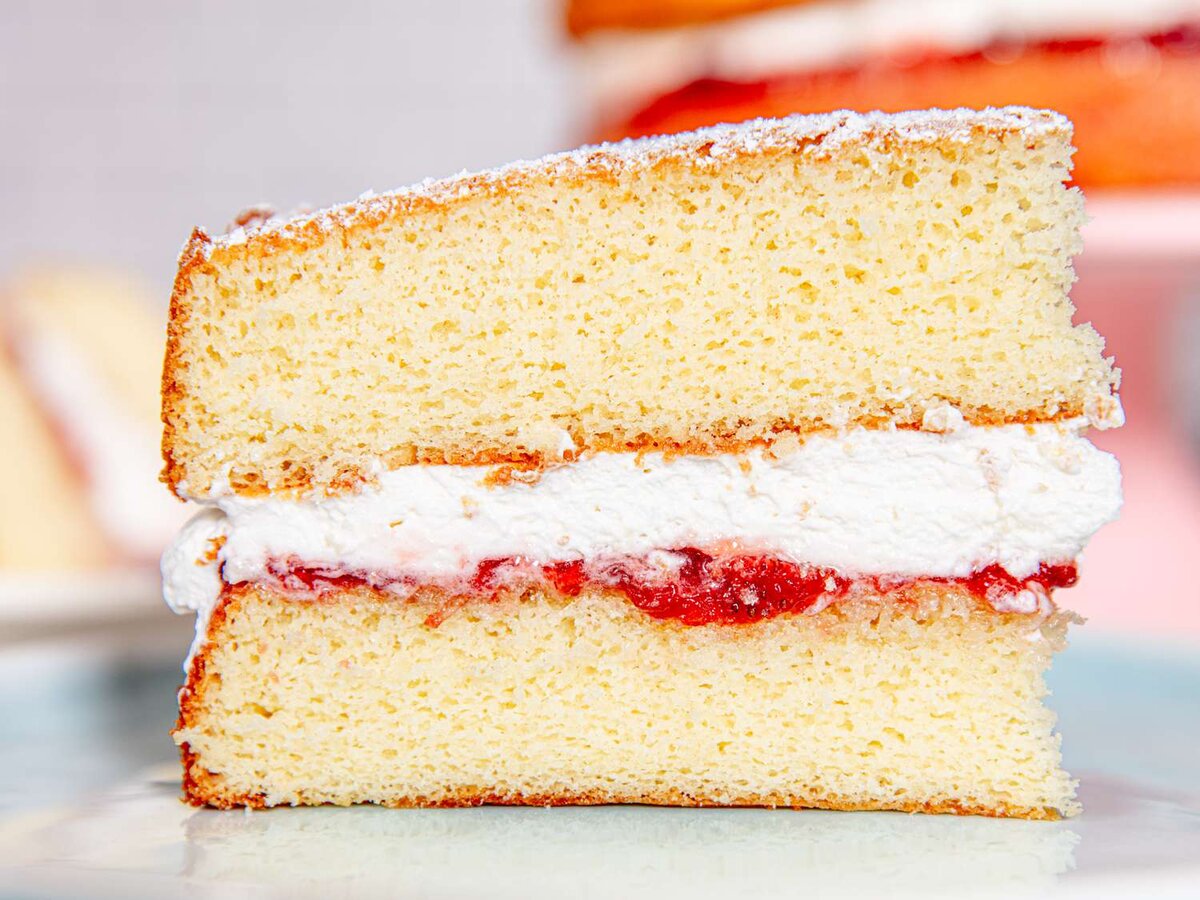
Built on the classic equal-weights method, this Victoria sponge is the friendliest cake you can bake. Two tender layers, a generous spread of jam and softly whipped cream.
Prep
20 min
Bake / cook
25 min
Serves
10
Level
Beginner
Ingredients
One 20 cm (8 in) two-layer cake
Sponge
- Unsalted butter, softened225 g
- Caster (superfine) sugar225 g
- Large eggs, room temperature4 eggs
- Self-raising flour225 g
- Baking powder1 tsp
- Vanilla extract1 tsp
- Whole milk2 tbsp
Filling
- Raspberry or strawberry jam150 g
- Double (heavy) cream200 ml
- Icing (powdered) sugar, to dust1 tbsp
Tip: eggs and whole items round to the nearest unit — use the scaler as a guide.
Run your menu through MenuCraft
Love baking by the numbers? Turn your full menu into a compliant, print-ready, smaller-portion version in 60 seconds.
Convert This Recipe Start free — no card neededMethod
- 1
Heat the oven to 180°C / 350°F / Gas 4. Grease and line the bases of two 20 cm (8 in) sandwich tins.
- 2
Beat the butter and sugar together for 4–5 minutes until pale and fluffy.
- 3
Add the eggs one at a time, beating well after each and adding a spoon of the flour if it looks like curdling.
- 4
Sift in the flour and baking powder, add the vanilla and milk, and fold gently until just combined.
- 5
Divide between the tins, level the tops, and bake for 23–27 minutes until golden and springy and a skewer comes out clean.
- 6
Cool in the tins for 10 minutes, then turn out onto a rack. Whip the cream to soft peaks.
- 7
Spread jam over one layer, top with the cream, sandwich together and dust with icing sugar.
Scaling notes
- •For three 20 cm layers, multiply by 1.5 and split between three tins; add 2–3 minutes to the bake.
- •To make cupcakes, this batter fills about 18 cases — bake at the same temperature for 18–20 minutes.
- •Equal-weights logic: butter = sugar = flour, with one egg (≈ 55 g) per 55 g of each. Scale all three together.
Ingredient substitutions
- •No self-raising flour? Use plain flour plus 2½ tsp baking powder per 225 g.
- •Swap the cream for buttercream (150 g butter beaten with 300 g icing sugar) for a sturdier, transportable cake.
- •Use lemon curd (see our recipe) instead of jam for a zesty twist.
Pan size
Written for two 20 cm (8 in) round tins. For 23 cm (9 in) tins the layers will be thinner — reduce the bake by about 5 minutes. For one deep 20 cm tin, bake 45–55 minutes and check with a skewer.
Oven temperature
Bake at 180°C fan-off (160°C fan / 350°F / Gas 4). If using a fan oven, drop the temperature by 20°C to avoid doming and dry edges.
Dietary variations
Use a gluten-free self-raising blend and add ½ tsp xanthan gum; rest the batter 10 minutes before baking.
Use block plant butter in the sponge and whip chilled coconut cream for the filling.
Replace each egg with 60 ml of unsweetened apple purée plus an extra ½ tsp baking powder; the crumb is slightly denser.
Baker's tips
- •Room-temperature ingredients trap more air and give a lighter crumb.
- •Weigh your eggs, then match the butter, sugar and flour to that weight for a guaranteed bake.
Baking Toolkit
Free conversion helpers — oven temperatures, pan sizes and ingredient weights.
Fahrenheit
356°F
Fan oven
160°C
Gas mark
4
| °C | °F | Gas | Best for |
|---|---|---|---|
| 140° | 275° | 1 | Very low / slow |
| 150° | 300° | 2 | Low (macarons, meringue) |
| 160° | 325° | 3 | Moderately low |
| 180° | 350° | 4 | Moderate (most cakes) |
| 190° | 375° | 5 | Moderately hot (pastry) |
| 200° | 400° | 6 | Hot (muffins, scones) |
| 220° | 425° | 7 | Very hot (bread, choux) |
| 230° | 450° | 8 | Very hot |